Jequié Campus , Saturday, October 10, 2026
Jequié Campus , Saturday, October 10, 2026


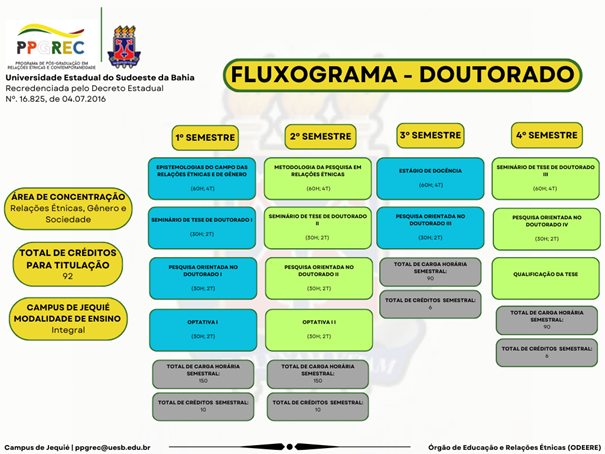
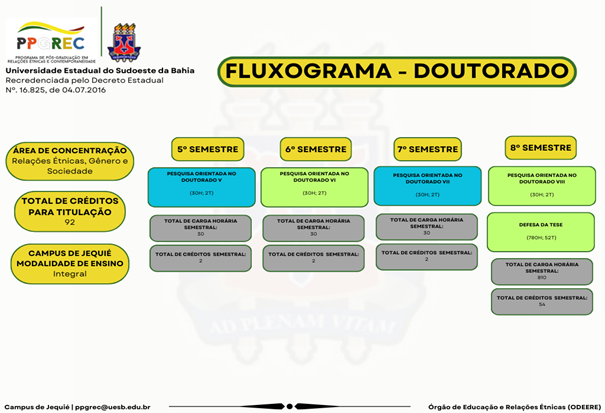
Curriculum and Flowchart – Doctoral Program
The curricular structure of the Doctoral Program establishes a maximum duration of 48 months. Scholarship recipients are required to comply with the maximum deadlines indicated above. Students who do not hold scholarships may be granted an extension of up to six additional months, provided that the academic advisor submits a formal request and justification to the Program Academic Committee and that the request is duly approved.
The curriculum of the Doctoral Program in Ethnic Relations and Contemporaneity comprises the following components:
I. Mandatory courses and academic activities;
II. Elective courses;
III. The Teaching Internship;
IV. Research Seminars;
V. The Doctoral Thesis Qualification Examination, to be completed by the end of the fifth semester;
VI. The Defense of the Master’s Dissertation or the Doctoral Thesis.
Mandatory and elective courses, as well as the Teaching Internship, are offered during the first four semesters of the program. The doctoral thesis consists of an original research project developed within the PPGREC’s area of concentration and must demonstrate scholarly originality and social impact. To complete the Doctoral Program, students must earn a total of 92 credits, of which 40 credits correspond to coursework and 52 credits to the thesis. These 92 credits correspond to a total workload of 1,380 hours.
The Supervised Research courses are designed to provide continuous academic guidance to students, with particular emphasis on participation in the two annual events organized by the Program, regular advisory meetings, engagement in research groups, and joint academic production with the academic advisor. These courses play a central role in monitoring students throughout their academic trajectory, fostering sustained engagement, academic support, and close attention to the demands that arise over the course of the program.
With regard to elective courses, Master’s and Doctoral students are required to complete at least two electives, corresponding to 4 credits. These may include newly created electives associated with the Doctoral Program or electives already offered within the Master’s curriculum. The Graduate Program in Ethnic Relations and Contemporaneity/Programa de Pós-Graduação em Relações Étnicas e Contemporaneidade (PPGREC) curriculum includes ten elective courses aligned with the PPGREC’s research lines at the Master’s level. With the implementation of the Doctoral Program, an additional nine elective courses were incorporated into the curriculum. Elective courses are offered on a rotating basis each semester. On average, three elective courses are offered per semester during each four-year evaluation period. With the launch of the Doctoral Program, the objective is to offer four elective courses every semester.
Elective courses are particularly significant because, in addition to contributing to the academic training of Master’s and Doctoral students, they enable the Program to reach students from other graduate programs as well as members of the broader community. Through the admission of special students, the Program also serves individuals who hold undergraduate degrees and wish to experience a stricto sensu graduate-level course in the field of Ethnic Relations.
(73) 3528-9932
Rua João Rosa, s/n, Pau Ferro, Jequié - BA. Referência: Antigo Colégio Dom Climério de Andrade.